

A meditation on texture, imperfection, and the human touch
I’ve recently been experimenting with watercolors and gouache in a way I never have before – I painted a few theatre set design renderings in college, but I’m very much a beginner. Still, in these last few weeks I’ve managed to produce quite a few illustrations that will probably wind up in some finished projects. There’s something about the texture of watercolors, and maybe in particular the texture of its mistakes, that lends itself to my work.

I’m fascinated by how different the textures of different visual forms feel, both the visual textures of the finished product and the physical texture of the act of creation. This isn’t really surprising, but it captures my imagination, especially when the natural texture of a medium, even when applied accidentally or mistakenly, is beautiful. It’s a huge part of what brought me to linocut: my first prints were splotchy and full of classic print errors, but those accidental textures worked for the piece, evoking a celestial starfield.

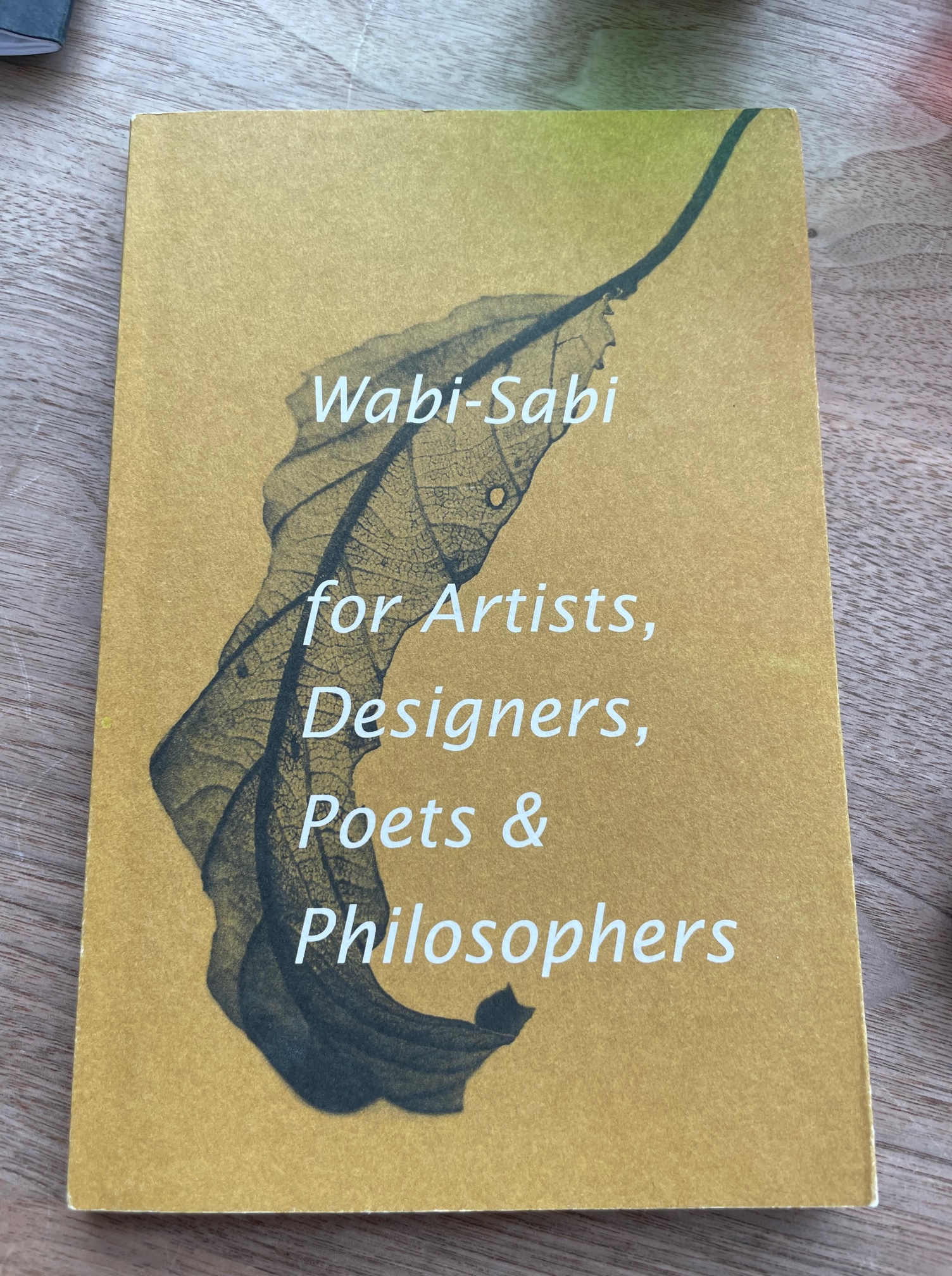
Encountering Leonard Koren’s Wabi-Sabi: for Artists, Designers, Poets & Philosophers in college helped me articulate how these accidents form a key part of my aesthetic. Wabi-sabi, as Koren explores at length, is amorphous and hard to define, but at its most basic it is “a beauty of things imperfect, impermanent, and incomplete.”1 It is “earthy, imperfect, and variegated”2 and explores “the beauty of the inconspicuous.”3
I think of wabi-sabi as fundamentally interpretative; for me, when I describe something as wabi-sabi, I’m usually describing the characteristics that signal to me it is human made and has some self-awareness that is is human made. This is usually so implicit that it’s hard to describe, but that self-awareness is a huge part of how I create work and present the work I create. I don’t want my work to feel like it was made by a mathematically perfect entity, a machine – I want it to feel like it was made by a human. I want my work to feel carefully made, yes, and beautiful in the way that carefully crafted forms can be, but I also want it to have a spontaneity, energy, and dynamism that I view as mutually exclusive with perfection. I want my work to celebrate the beauty of the human touch at play in creation.
From my background in theatre, the human touch is obvious; it’s the point. If you’re doing theatre and you’re not utilizing the fact that you have real people on stage in front of a live audience, you’re not making the most of the medium’s potential. That human touch is also obviously flawed; live performances are vulnerable to flaws recorded performances on film and TV are not. But the live nature of theatre gives it a unique storytelling power that film and TV lack. This is true of every creative medium: we create work in certain mediums not merely because they are available to us, but because every medium has distinct properties that give to it a unique creative power. Whatever kind of storyteller you are, there are mysteries and wonders to unravel in your forms, and your form is implicitly a part of the stories you tell.
For me, I like seeing brushstrokes and fingerprints. I like imperfection; I like wabi-sabi. Seeing the imperfection and randomness of human-made textures is much more beautiful for me than something perfectly neat or clean. Imperfection is visually interesting. Imperfect textures allow for dynamism, contrast; they carry the eye on an interesting journey in a way that the uncanny perfection of AI or the monotonous drab of Netflix Sheen never could. You also get a certain depth from seeing a glimpse of its creation and a sense of its impermanence; you understand implicitly that you are interfacing with another human, examining a creation that, in a perfectly indescribable way, holds a part of themselves. If it resonates with you in a certain way, you might even get a sense of how you could create something like it yourself.

This resonance is an important, beautiful part of the interactive storytelling I hope to create with my art. In Retrograde’s stories, no one stands aloof. There is no omnipotent, detached narrator, and there is no audience watching flatly behind a screen or across the page. It is all about the interaction of people, the stories we tell together, and the way that we intervene in a problem presented to us. In other words, it is about creating and learning to create together. I’m eager to share where these journeys of creation continue to lead me.
Thanks for reading!
– Nathaniel
Leonard Koren, Wabi-Sabi: for Artists, Designers, Poets & Philosophers. Pg. 7.
Koren, pg. 26.
Koren, pg. 22.
 The Library of Zosimos
Leave a comment