
Retrograde’s Core Mechanic, And How It Came To Be
I hadn’t realized that designing an RPG system would be a daunting task – my group’s GM had done it easily enough, it seemed to me, by combining rules from two different systems we had played into something that utilized the strengths of both in a compelling and original way. I began designing The Retrograde System the same way, taking bits and pieces from different games I liked, shaving away pieces I didn’t need and putting my own new spin on them.
It wasn’t until I started polishing my ruleset to share with folks online when I realized that a lot of people thought of what I was doing as kind of crazy. I’ve seen folks on Reddit ask RPG designers, quite simply, why they go through all the work of creating their own RPG systems when they could simply write adventures for pre-existing rulesets. But, truly, designing my own system seemed like the easiest way to get my ideas out into the world: I knew that the game worlds I wanted to create would work better with rules designed just for them, rather than trying to fit them into the structure of a pre-existing system. I was not perfectly satisfied with the mechanics of any one system I had experienced as a player, and ultimately I wanted to design a game that I would enjoy playing, no matter how crazy the process of creating it would be.
I began my design process by setting objectives for the kind of game I wanted to create and articulating some elements from other games that inspired me as a jumping-off point.
Objectives:
I wanted a ruleset that prioritized roleplaying and storytelling – this was a good general objective to guide the rules to be something I myself would enjoy playing, and it would also help to reign in rules bloat; if certain rules were unnecessary or inhibitive to storytelling, I didn’t need them.
I wanted my ruleset to be accessible, easier to pick up and play for total RPG beginners than some more complex RPGs.
I wanted to design a new system with as few character stats as possible – fewer stats would make both character creation and actual play quicker. Simpler character creation allows you to start playing quicker, and with fewer places to look for information, finding the information you need for a given situation during play is faster and more straightforward.
I wanted to incorporate rules for a character’s health and hit points beyond their physical health – I thoroughly enjoyed the Sanity and Stability system in Trail of Cthulhu, and I wanted to further explore mechanics for mental and emotional dangers.
I wanted the stakes of play to raise as an adventure progresses, ideally reflecting that through a dynamically changing mechanical element.
Influences:
Trail of Cthulhu is the investigative RPG I’ve played most, and my experiences as a player with the ruleset heavily influenced Retrograde’s design. Trail of Cthulhu’s usage of skills as resource pools is very compelling to me, and while I chose a much smaller skill roster in favor of simplicity and accessibility, I like how “complete” my character’s skills feel in Trail.
I have never actually played a game of Mothership, but on paper it really compels me. I’m particularly interested in how character skills are structured – in my personal opinion, I like having social skills because it helps simplify some social encounters that can get muddy without a clear mechanically-influenced outcome, but Mothership’s omissions of common RPG stats like Stealth made me think more about how I might implicitly incorporate some game situations into tangential stats rather than carving out more explicit stats.
Although Disco Elysium is a video game rather than a TTRPG, it has some really fun, unique skills in its skill system that inspired me – some of Disco Elysium’s Physical skills like Shivers and Half Light are special favorites of mine, and made me think about how a character’s thoughts and feelings could be incorporated as a Skill mechanic.
After some experimentation, these objectives and influences coalesced into the core of the Retrograde System’s design: the Skill Check. Here’s how Retrograde’s Skill Checks work:
When a character attempts to do something that is not obviously feasible, the Game Master (called the Librarian in Retrograde) calls for a Skill Check for a specific Skill. The player rolls 2D6 and compares the result to their current points for that Skill. The current value of your Skill Points is the Success Threshold for that Skill Check.
If they roll less than or equal to their current Success Threshold, they Succeed.
If they roll greater than their current Success Threshold, they Fail.
If a player Fails a roll, they may spend a point in that Skill to turn the check from a Failure to a Success. This spent point reduces that Skill’s Success Threshold: the more you Fail, the harder Success becomes.
Currently, players have a total of 72 points spread across 18 Skills, with each Skill sorted under 3 Attributes of Mind, Body, and Soul. This is what a character’s assigned Skills look like on their character sheet:
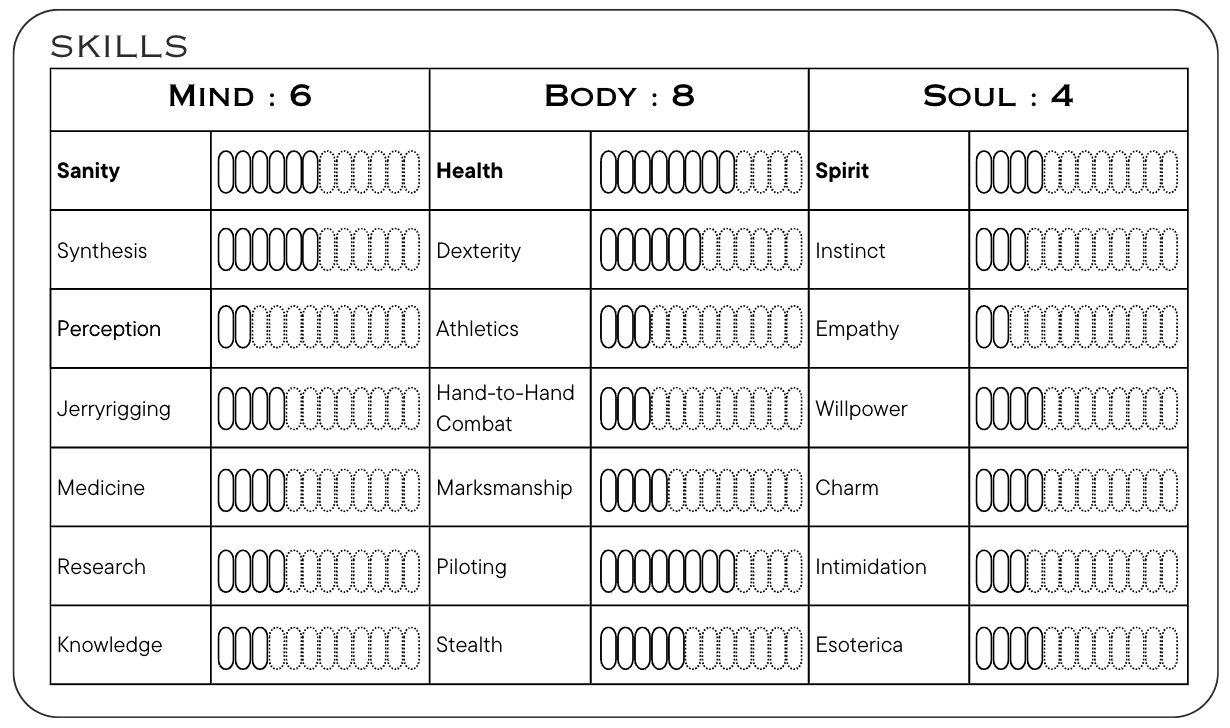
Assigned Skill Points are indicated by bubbles with a black border – all Skills must have a minimum of 2 points assigned to them, and the values of the character’s Attributes set the caps for their relevant skills, ex. with a Health value of 8, the maximum points that can be assigned to the Piloting Skill is 8.
This is what this looks like during play:
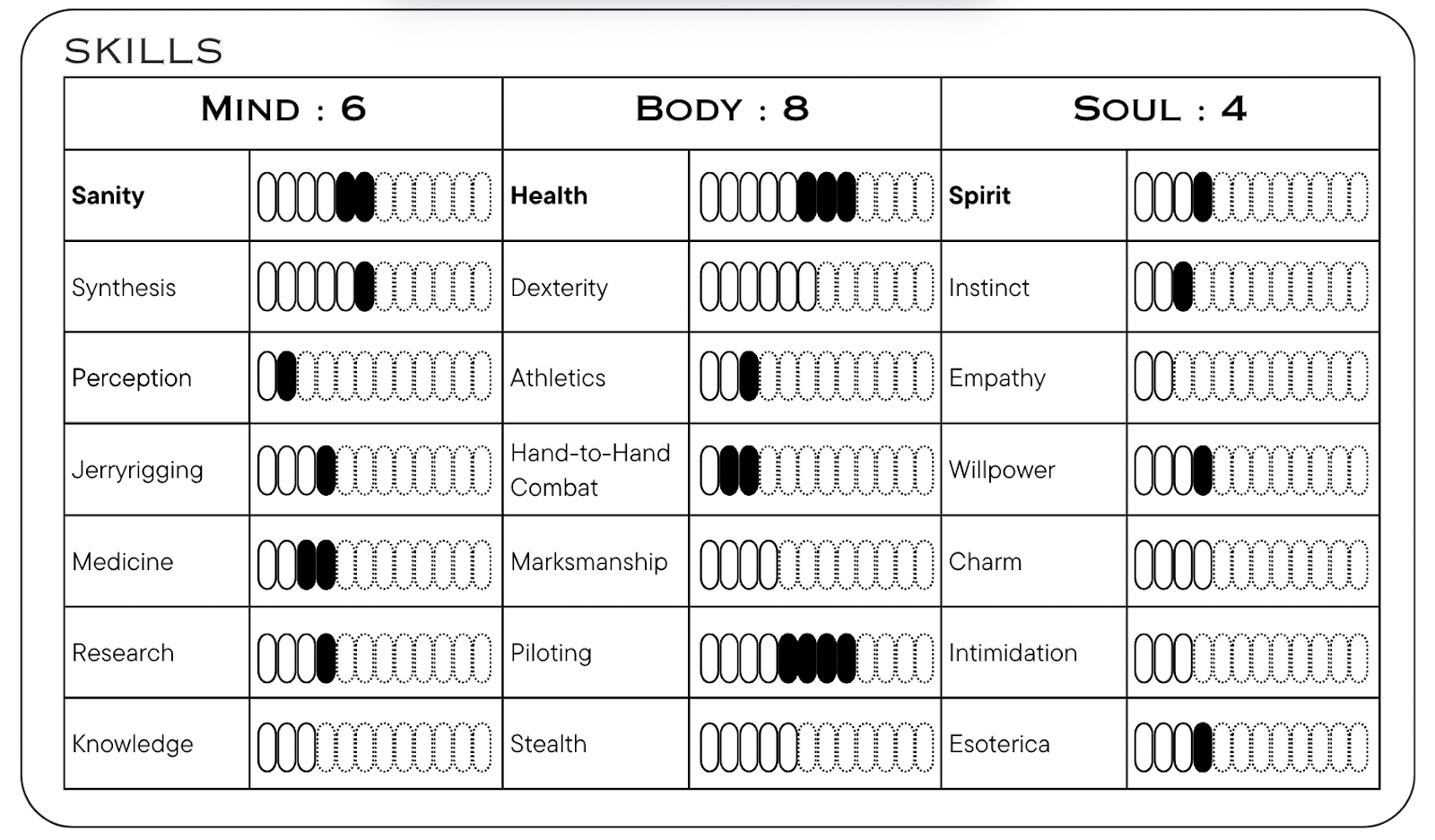
Currently, I have players filling in the right-most bubble with a pencil to show that that Skill Point has been exhausted – characters can regain spent Skill Points with Rest and Healing. I’m aware that filling things in from right-to-left rather than left-to-right may be confusing, but currently it feels like the best way to clearly portray how many Skill Points a character has left – I’m very open to changing that if most players find it too unwieldy.
The current setup of Retrograde’s Skill Check mechanic accomplishes a lot for me:
It incorporates mechanics for stress, fear, and exhaustion into Skill Checks themselves by making successful Skill Checks more difficult the harder you push your characters, removing the need to make those separate stats and add further mechanical complexity.
It allows for all rolls to be made with D6s, simplifying the process of making rolls (no sorting through to find the right dice) and making the game more accessible (D6s are the most commonly available dice, especially outside of RPGs)
It reflects thematic elements of the game as a whole; exhaustible resource pools feel right for a game called “Retrograde,” implicitly expressing a “reverse motion” analogous to the retrograde movement of celestial bodies.
It feels distinct and fairly unique: while I’m sure they may exist, I am not aware of another system that similarly use the current value of resource pools as the success threshold in the way that I have it structured in Retrograde – if you are, I’d be super curious to check it out!
Current playtesting and feedback has made me more or less confident in the general structure of Retrograde’s Skill Checks, but I’m aware that the exact number of starting Skill Points may need tweaking depending on the perceived difficulty level and the pacing of different adventures. In their rulebook, Trail of Cthulhu suggests different numbers of skill points per player for different difficulty levels, and I may include a similar recommendation for Retrograde. I’m also considering having a different number of skills or maybe a different points spend system to make things more fast-paced for one-shots.
What do you think? Do you think Retrograde’s Skill Check system as I have it laid out here is accomplishing my design objectives? Do you see anything you would modify for your games? If you have any thoughts about Retrograde’s rules, I’d love to hear them!
If you’re curious to explore more of Retrograde’s rules, you can read an early access version of the Condensed Rules on my website here. You can also follow our Kickstarter page here and be the first to learn when the full version of Retrograde goes live! If you’re not already, subscribe to the Library of Zosimos to see more of the behind-the-scenes action of Retrograde’s development!
Thanks for reading!
– Nathaniel


Leave a comment