
A mechanical post-mortem of my first original system
A little over a year ago, I launched Retrograde on Kickstarter, properly kicking off my first real foray into RPG design. I’d spent a year designing Retrograde’s ruleset, and this past year I continued running games beyond the initial playtesting and employed the system in a new game, Ephemeris, with nuances and intricacies appearing as the system percolated over play. I’m continuing to develop Retrograde and adapt the system for new games with new styles of play, and as I begin those new design journeys, I’m thinking about what works with the ruleset and what I’m looking to change as the system finds new life in new games.
If you’d like to follow along with the full system as I break it down, you can download Retrograde‘s core rulebook free here.
What Works – Retrograde’s Skill Checks
The central mechanic of the Retrograde System works exactly how I hoped it would. A character’s skills serving as both the success threshold for making skill checks and a resource pool they can spend to modify those checks allows for strategic play and critical high-stakes moments where a character’s fate is decided by the roll of the dice.
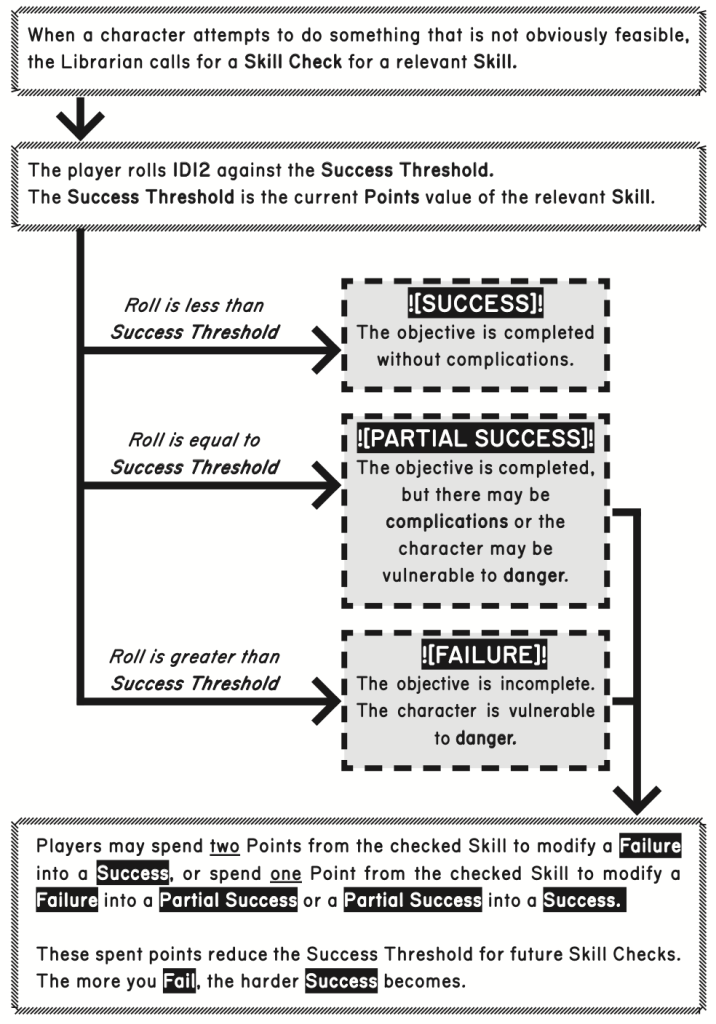
A core objective of this design was to allow players to ensure their characters could succeed at things they’re supposed to be good at even if the dice are against them. Not only are you more likely to succeed a skill check if you start out with several points in it, you’re guaranteed to succeed at least a few times because you’ll have points to spend if you fail your rolls.
Eventually, however, you will run out of points – seeing your skills tick down heightens the tension of play, and deciding whether or not to spend points adds an element of strategic decision-making. This is especially true if your points in a critical skill are depleted – you’ll have the risky choice between failing the check or spending your hit points.
As a player, this is just the right mix of luck and strategic play for me. I like having moments where my character’s expertise really shines, but I’m also very comfortable with the consequences of being a specialist and having to make sacrifices or take hits because I just can’t be good at everything.
I love how truly central this mechanic is to Retrograde. Pretty much everything else in the ruleset builds off or modifies how this mechanic works (I really need to make a one-pager version of Retrograde, because I think it would totally work as one). I designed Retrograde to be a modular system, with players free to graft on subsystems they like and strip away any mechanics they don’t need, and I think the skill check mechanic is both solid and dynamic enough to facilitate this.
Things To Keep Exploring – Character Creation, Partial Successes, the Hit Points Triad, False Symmetry, Death and Dying
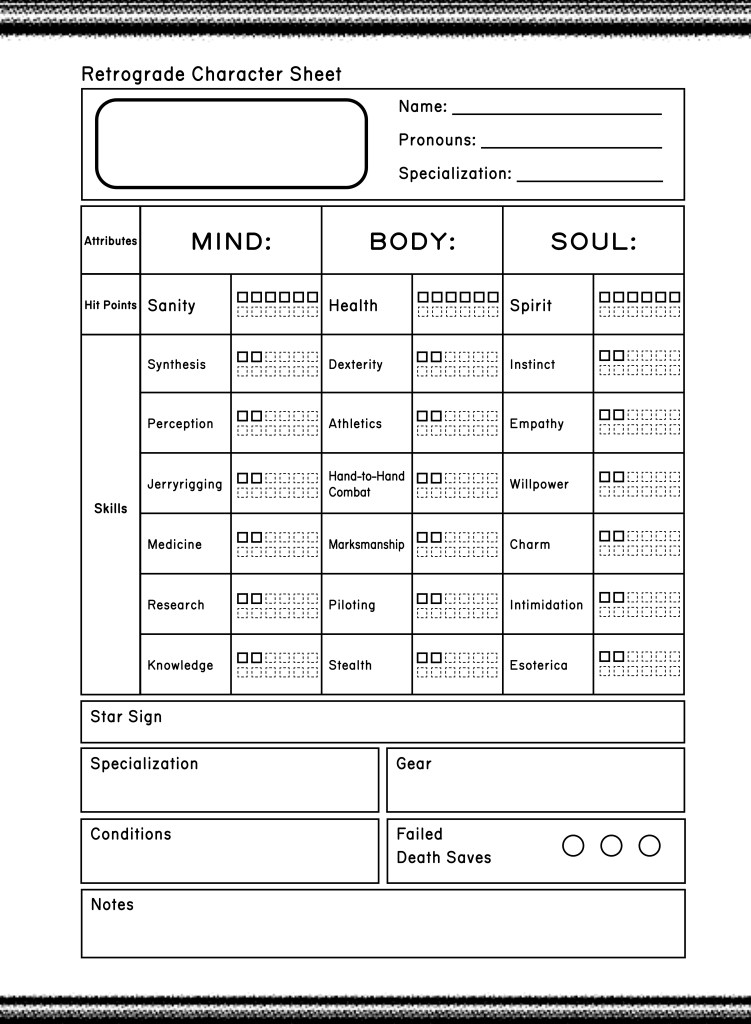
Character creation is something I want to make more streamlined in the future. Currently, the points buy is a bit intricate and requires double-checking your arithmetic to get right – 64 points spread across 18 skills is kind of a lot to manage. I think the most straightforward change, reducing the total number of skill points, would necessitate changing the dice employed to arrive at similar odds, probably changing the d12 to a d10 or d8.
This would also waterfall into removing partial successes, which I have mixed feelings about. Partial successes can create really dynamic game moments where the core action progresses while introducing new conflicts the players have to confront, but it undeniably adds complication and adjudicating how partial successes work can be situationally tricky for a GM. If skills were on an 8-point track rather than a 12-point track, I would probably remove partial successes and have a 1-point spend modify a failure to a success rather than a 2-point spend. Truthfully, I’m not sure what the best choice to make here is, but I’ll certainly explore it in future playtests.
I’m also looking to solve a problem with the unclear boundaries between the Sanity and Spirit hit points and how to determine if a given psychological threat is going to prompt a Mind Save targeting Sanity or a Soul Save targeting Spirit.
As written, Sanity is your grip on reality, and Spirit is your willpower and emotional self-control. Psychological threats can obviously impact both – a lovecraftian horror is certainly going to damage your grip on reality, but it’s also just terrifying. Having to determine if any given threat prompts a Mind or a Soul save is a headache for the GM when there’s obvious overlap between the two.
Part of the problem here comes from the design objective I had of making the characters’ attributes (Mind, Body, and Soul) of roughly equal importance by attaching a different hit point to each of them. I do think the system accomplishes this, but I’m not sure it’s the right objective. Some more asymmetry here is probably okay, and may even be good – it’s certainly worth exploring when I playtest my next Retrograde-system game.
I may experiment with the Sanity/Spirit dynamic looking more like Trail of Cthulhu’s Sanity/Stability dynamic, where Spirit is damaged by short term shocks and is healed fairly easily, while earth-shaking cosmic horrors and critical damage to Spirit will tick down Sanity points that are much more difficult to heal.
It’s also easy to imagine a yet more elegant solution: not having any kind of psychological hit point at all. Retrograde is implicitly geared towards games with a horror element, especially cosmic horror. Not all adventures need to have an element of psychological danger, and in such games I don’t think anything would be lost by simply removing Sanity and Spirit as stats entirely.
Similarly, one of the most intricate parts of the current ruleset is how death and dying work. There are unique consequences to falling to 0 points of either Sanity, Health, or Spirit that stay with a character after they heal. I like those consequences, but there is probably a way to make dying more dynamic than the three failed death saves that exists current state. That design decision was made to keep things from being too punishing for the players, but I’m not sure it’s dynamic enough to add much to play, and I don’t think the game would be unfairly punishing without it.
Most of these points are about pieces of the ruleset that don’t add much to play – these are all elements I can probably trim pieces off of without losing anything fundamental about the game. If you have any thoughts on any of these points from your own Retrograde play-throughs, please feel free to share! I’d love to hear what other players think and make the game play how you want it to play.
Takeaways and Experiments to Come
My takeaway from this post-mortem is that defining what you want your game to do is really important for allowing it to become that. Articulating design goals for yourself allows you to check if any given mechanic is working towards those goals. In our ever-growing RPG ecosystem, it’s more important than ever to know what play experience you want your game to give your players. That doesn’t just help you market it, it helps you design something sharp and precise that gives your players a distinct and specific experience. It’s also critical for making playtesting and feedback useful – you need to know what kind of game you’re making so you can ask players if it’s functioning as intended, rather than if it’s simply the kind of game they enjoy playing.
Retrograde is not a one-size-fits-all system: it’s designed for fast-paced games focused on investigation, exploration, and survival, and it works especially well for horror games and for players who want a dynamic mix of luck-based resolution and strategic play. Still, I think there’s yet more potential in the core mechanic to unravel, and in my next games I’ll use the mechanic as a jumping-off point to explore different styles of play.
Right now, I’m reimagining the Retrograde system for The Broken Seal, a science-fantasy RPG that will combine creative elements of keepsake games like mapmaking and bookbinding with the kind of OSR-inspired adventuring mechanics Retrograde offers. The Broken Seal is still in early pre-production, but it’s likely to materialize as some kind of hex-crawl, which I think Retrograde’s skill system will work great for – rather than it being a desperate race against a ticking clock, it will become a cycle of adventure and rest. How far can you venture in a day before you run out of energy and resources? After an exhausting encounter, can you press onward to make it to the next town’s inn, or do you have to camp for the night and take what rest you can? I think the cycle of adventuring and recuperating here will be a great use of the Retrograde system my current adventures don’t fully explore, and the recuperation part of the equation will be a great opportunity for some of the creative keepsake elements to come in.
The pots are simmering – I have a lot of great lessons to draw from Retrograde as I embark on new designs, and I’m eager to keep exploring what new experiences I can capture in my games. If you have any ideas for how you’d like to see the Retrograde system employed going forward, feel free to share – I’d love to see the new worlds these adventures lead. Cheers y’all!
– Zosimos


Leave a comment