
How Retrograde feels at the table
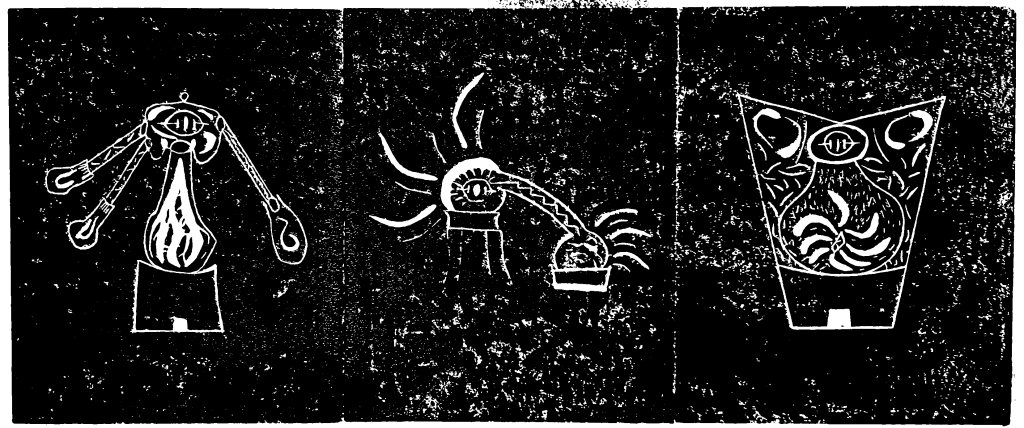
You strap in to your jump seat as the crew of the presser begins the ritual of Blood Ink Teleportation, mixing their blood into mystically charged ink as they recite secret words of power. The presser’s great cylinders roll over a print form depicting a star system some 200 light years away, printing a bloody map onto a giant canvas. A ghostlight celestial display plays in the cabin: stars whizz round, a celestial orrery in miniature spinning wildly and erupting in cosmic fire, your eyes glazing over as your mind struggles to process the sights before you. You blink, and all is calm. From the viewport, you see a completely new set of stars.
With frostbitten fingers, you desperately page through tattered research notes and geologic surveys, searching for any clues to how to stop the eerie, howling voices on the wind driving you to insanity. The voices are growing louder – they’re shouting your name with awe and terror.
Enjoying an espresso in a charming cafe, the radio suddenly crackles with static. You make out a voice – it speaks what sounds like poetry, what feels like a riddle. When you look back at your map of the town, it’s changed somehow – the illustrations are different, the descriptions changed, somehow wrong. The others at your table heard it, no one else has. A stone drops in your stomach – this world is not the real world.
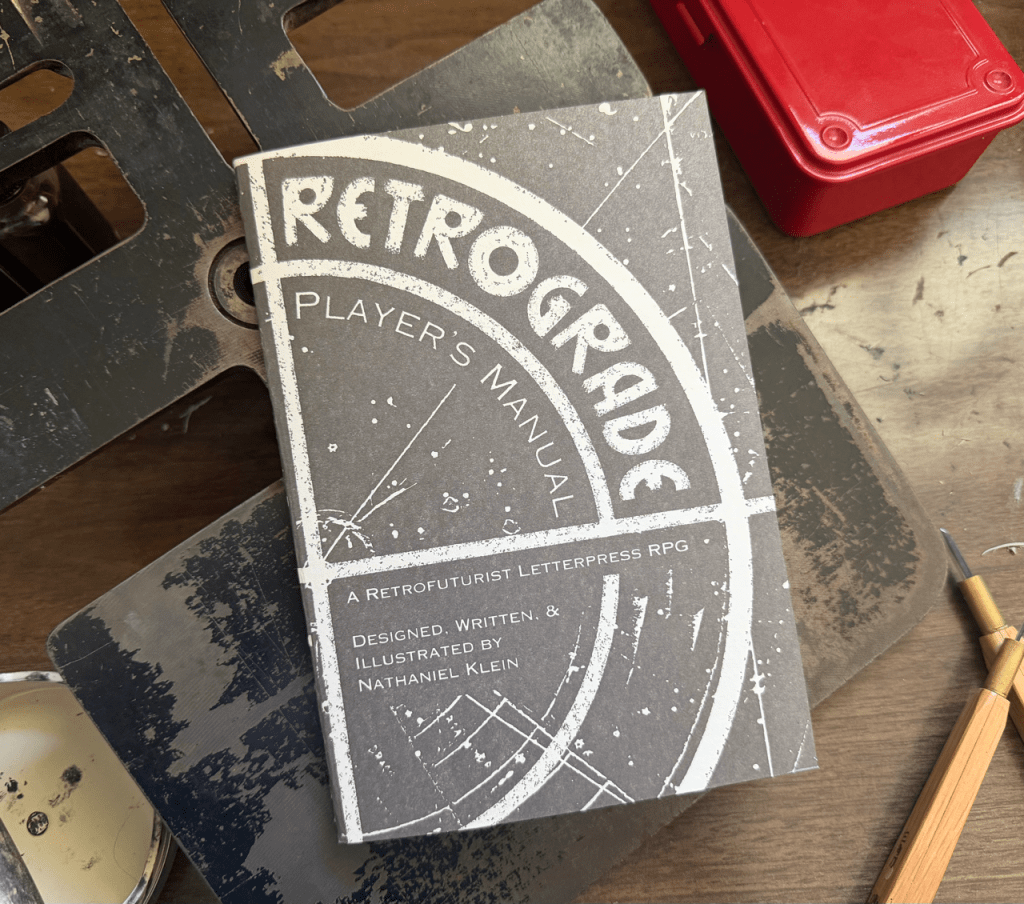
These are the kinds of situations your characters are liable to find in a game of Retrograde. With some conventions and art fairs coming up soon and Ephemeris just about to be on its way to our Kickstarter backers, I’m hoping Retrograde finds its way to new players, and I’d love to give them a taste of what Retrograde looks like at the table. If you’re curious about how Retrograde plays, you can download the Player’s Manual free here.
As a Player
Making Checks, Spending Points, Getting Your Hands Dirty
The surgeon sweats as they perform a field surgery, but their hands don’t shake.
The marksman’s heart pounds as the din of battle spins all around them, but as they line up their shot everything stills, and their aim strikes true.
The corner of the spy’s lip switches as they speak, but their voice is calm and strong, their deception confident and natural.
Retrograde’s Skill System mechanically drives the game forward, and implicitly heightens the tension by depleting the player’s skill points: spend points to turn failure into success, but the more you fail, the harder success becomes.
The good news is that what you’re good at, you can do, almost guaranteed – investing several points in a skill means you’ll be able to spend points to succeed several checks if necessary. Characters also roll with Advantage when they make a check using their specialization, further increasing their odds of success. This means players can trust that their character will have time to shine in every adventure – even if the dice are against you and you’re spending points more often than not, you will be able to guarantee some success.
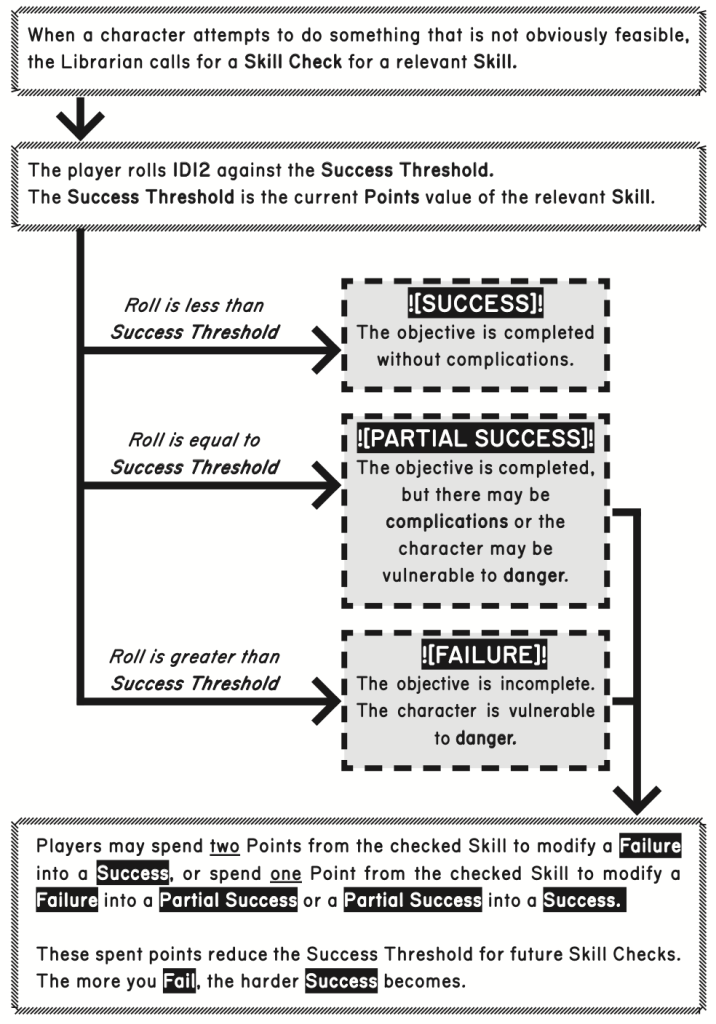
The bad news is that you’re forced to specialize, and there’s always going to be something you’re bad at. This is important to give the game tension and makes players’ actions have real, sometimes negative, consequences. When the challenges and dangers facing a character are so great that they find themselves clinging to their last skill points, they can spend their hit points to modify checks instead. This of course pushes a character even closer to the brink, and dancing on that knife-edge is where so much of the tension, challenge, and fun of play comes.
The depletion of a character’s skill points simulates stress, frustration, and exhaustion the character encounters as they adventure, wearing themselves down mentally, physically, and spiritually. Incorporating this kind of depletion directly into the skills is quicker and cleaner than having a separate stress stat to check, and offers some fun material for roleplay, and even role-playing strategic decision-making: an experienced fighter knows that they must pace themselves if they’re going to survive a long bout. A researcher knows when they’ve been staring into a stack of books for so long they stop truly processing what the words on the page mean.
Strategic play might feel curious from a ludonarrative perspective, but we have pretty decent awareness of our limits. When you feel like you’re hitting a wall at work but know you have another three hours to go before you can clock out, and then you’ve got cooking and dishes and laundry to do at home, it’s incredibly demoralizing. Now imagine that in a life or death scenario – you’re bloodied, terrified out of your wits, with a big alien bug eviscerated on the floor in front of you, and you’re hearing angry buzzing behind the one door that lead to the escape pods. What the hell do you do? That’s what Retrograde throws your way.
As a GM
A stocked toolkit ready to help you improvise and react
When I run Retrograde, I barely ever prep. Part of that is admittedly because I’ve written the adventures I run so the info is implicit in mind, but another is that, mechanically, everything I need is right in front of me. Apart from final bosses who may have some unique abilities or spells, most NPCs are mechanically straightforward: as the Librarian, you’ll make even simpler skill checks for NPCs than players make for their characters, using their Mind, Body, and Soul stats rather than individual skills.
At the table, Retrograde is essentially as complex as the GM and the players want it to be: using the rules for Partial Successes adds some complexity to determining the results of the player’s actions, but the rules explicitly give the Librarian the option to disregard Partial Successes if adjudicating their consequences adds unwanted complication.
The Librarian also has the ability to adjust the complexity of the game mid-stream with reactive elements. You don’t have to think about this at all if you don’t want to: the players will encounter what they encounter according to what’s outlined in the adventure guide, and that’s great and awesome and should give you very satisfying moments of play. But if you find it useful to turn up the heat, every adventure contains a ticking clock that will create consequences players have to deal with once that clock ticks down. It’s a simple idea, but wielding the danger of the problem coming right for the players if they don’t come upon it first gives you as the Librarian the power to throw new conflict at the players and roll with wherever they decide to go.
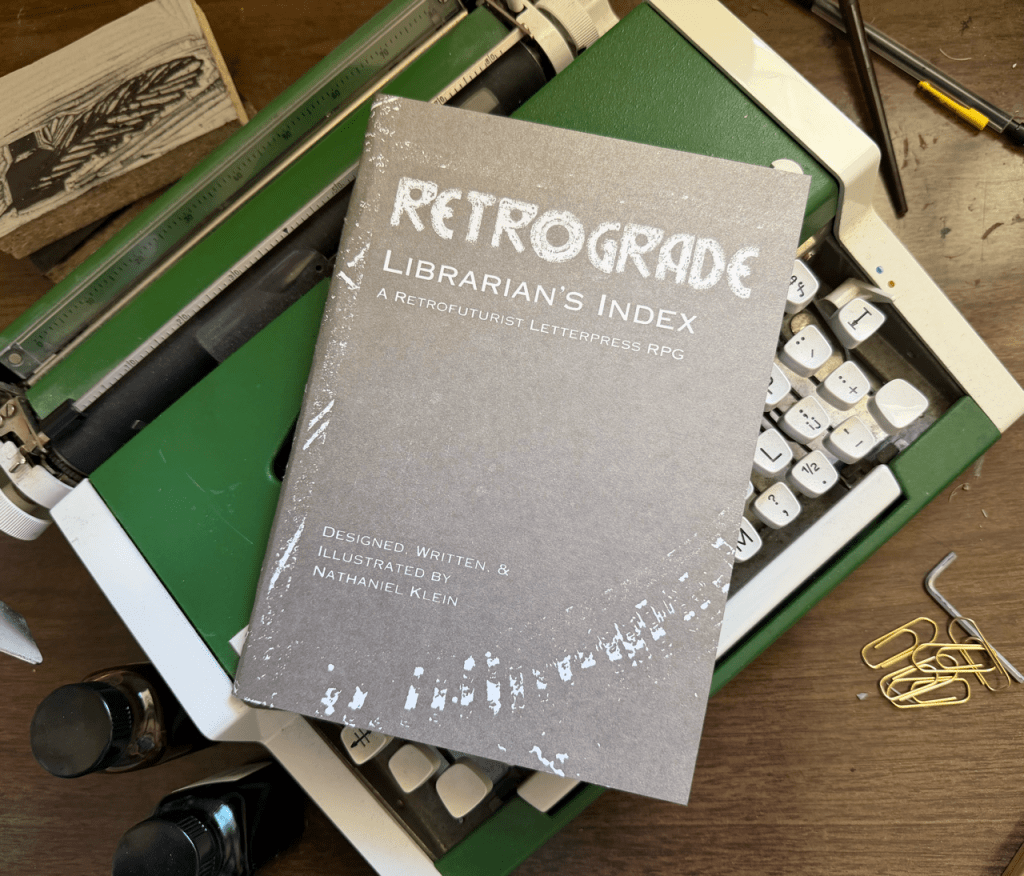
If you’re curious about what tools Retrograde provides its gamemasters, you can check out the Librarian’s Index free here.
I’ve been enjoying running Retrograde at my tables over the course of the last year, and I’m continuing to think about improvements I can make to the system and changes I’ll make to adapt it for other settings and play experiences. If you have any thoughts on things you’d like to see changed, I’d love to hear them, and I hope y’all have nothing but fun exploring Retrograde’s occult cosmos. Cheers y’all!
– Zosimos


Leave a comment